
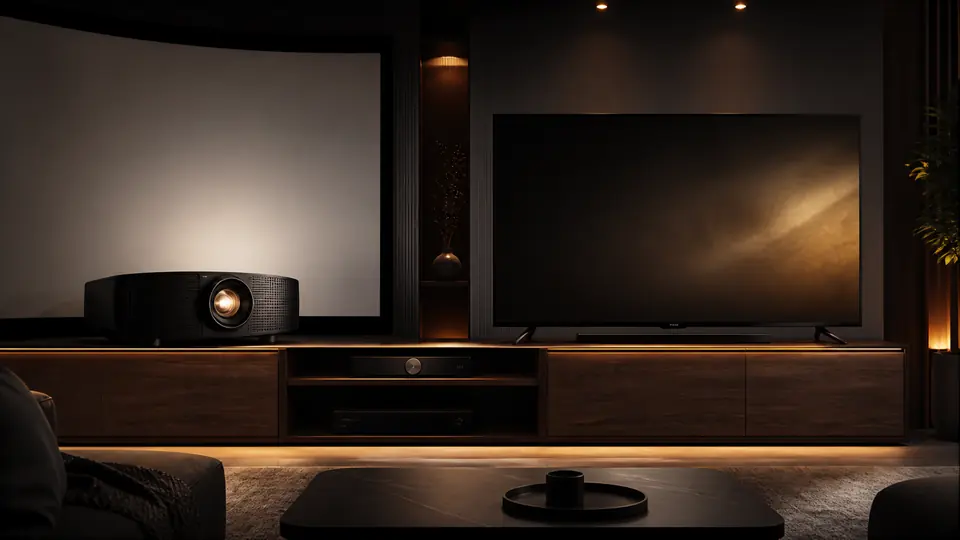
Should your home cinema use a projector or a large television? The answer depends on image size, room lighting, viewing habits and how much of the room can be designed around the screen.
A projector is not automatically more cinematic, and a television is not automatically more practical. Each can be excellent when matched to the right room.
Choose based on the room, not the showroom
Bright retail displays are designed to attract attention under strong lighting. A dedicated cinema is a different environment. Before comparing models, establish:
- viewing distance
- desired image size
- control over windows and room lights
- available wall area
- speaker placement
- mounting and cable routes
- equipment ventilation
- how often the room will be used during daytime
These factors narrow the choice more effectively than starting with technical specifications.
Where a projector has the advantage
Much larger images
Projection becomes compelling when you want an image significantly larger than mainstream televisions. A large image can fill more of your field of view and create the scale associated with a commercial cinema.
Flexible screen formats
A projection screen can be selected for the room and, in some designs, allow speakers to sit behind an acoustically transparent surface. This helps dialogue appear to come directly from the picture while keeping the front wall visually clean.
A softer visual presence when switched off
A fixed screen can blend into a dark front wall, while a retractable screen can disappear in some multi-purpose spaces. This may suit interiors where a large reflective television panel would dominate the wall.
Where a television has the advantage
Better performance with ambient light
Televisions generally maintain stronger contrast when windows or everyday room lights are present. This makes them attractive for lounges and media rooms used throughout the day.
Simpler installation
A television does not require a projection path across the room. Mounting, source connections and alignment are usually more straightforward, especially in compact spaces.
Consistent brightness and everyday convenience
There is no lamp warm-up, projector alignment or risk of someone walking through the beam. For mixed use—news, sport, gaming and films—a television can be the easier daily choice.
Light control is the deciding factor for projection
A projector creates an image by reflecting light from a screen. Other light in the room also reaches that screen and reduces perceived contrast. Curtains, door seals, lighting zones and dark finishes near the screen can therefore be as important as the projector itself.
This does not mean every surface must be black. It means controlling direct light on the screen and avoiding bright reflective finishes in the viewer’s field of vision.
If the room cannot be darkened during the hours you watch most often, assess a large television before forcing projection into the space.
Think about screen size and viewing distance together
An oversized image can be tiring, while a small image viewed from far away loses impact. Test the planned dimensions on the wall with masking tape or a temporary projected image. Sit in the intended seats and watch varied content, including subtitles and bright scenes.
Also confirm that the bottom of the image will remain visible over furniture and any front row. In rooms with multiple rows, sightlines may affect both screen height and platform design.
Sound placement can change the decision
The centre speaker carries much of the dialogue. With a normal television or solid projection screen, it is usually placed immediately above or below the image. Its height and angle should keep dialogue connected to the picture.
An acoustically transparent projection screen can allow the centre and front speakers to sit behind the image, similar to a commercial cinema. This needs adequate wall depth and a screen material suited to the design.
Do not finalise display size without reserving space for the speakers.
Consider heat, maintenance and access
Projectors need ventilation and access for cleaning or servicing. Their light sources have operating-life considerations, although the details vary by technology and model. Mounting should allow safe maintenance without disturbing the finished ceiling.
Large televisions also need ventilation and safe mounting. Confirm that the screen can be brought into the room through doors, corridors and stairs before purchase.
For either option, protect sensitive electronics with an electrical strategy appropriate for the site. Power, grounding and backup requirements should be reviewed by a qualified electrical professional as part of the project.
A practical decision guide
Consider a projector when:
- the room can be made properly dark
- a very large image is a priority
- the room is mainly for films and immersive viewing
- the projection path and mounting can be planned cleanly
- you want the option of speakers behind the screen
Consider a large television when:
- the room has regular daylight or shared uses
- simplicity and quick everyday viewing are priorities
- the viewing distance suits an available television size
- the room cannot accommodate a projector position
- strong contrast with some ambient light matters more than maximum size
The best answer may change from one room to another in the same home. Cinema Builders evaluates the display together with seating, sound, lighting and budget. Read our complete room design guide before fixing your layout, or contact us for a site-specific recommendation.